
Panel Discussion at the Stanford Robotics Center | From Foundation Models to Working Robots: What It Actually Takes to Close the Gap
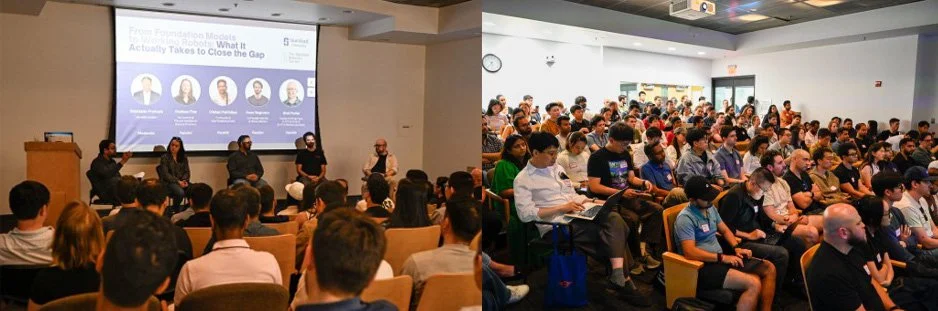
The Stanford Robotics Center recently hosted a panel discussion titled “From Foundation Models to Working Robots: What It Actually Takes to Close the Gap.” The conversation brought together leading voices in robotics, Physical AI, and deployment to explore what it will take to move robots from impressive demonstrations into reliable use in homes, warehouses, hospitals, and other real-world environments.
Moderated by Shantanu Prakash, the discussion focused on a central question: as foundation models become more capable, what still needs to happen before they can create dependable customer value in the physical world?
Across the conversation, the panelists emphasized that progress in robotics will depend not only on better models, but also on evaluation, safety, customer workflows, data collection, hardware design, and deployment discipline.
Five themes stood out from the discussion:
1. Evaluation is becoming one of the biggest deployment bottlenecks
As robot policies improve, the harder question is no longer simply whether a robot can complete a task. It is whether a new policy improves performance without breaking throughput, predictability, safety, or the specific workflow a customer has built around the existing system. In deployment, a “better” model can still become a worse product if the evaluation process does not capture real operating constraints.
2. Egocentric data and robot data may be complementary strategies
The panel explored the role of different data sources in scaling robot learning. While training on massive amounts of human egocentric video is a compelling and scalable path, the Physical Intelligence team found something counterintuitive: transfer from human video to robots actually improves when the training mix includes a large, diverse set of real robot embodiments. The optimal strategy may not be choosing between the two. It may be sequencing them correctly
3. Safety has to emerge from the intelligence itself
The panelists emphasized that safety in robotics cannot be treated only as a fixed constraint layered on top of behavior. Whether an action is safe depends heavily on context: what object is being handled, where the robot is operating, who is nearby, and what the consequences of failure might be. This makes certification, regulation, and deployment more complex than in purely digital AI systems.
4. Foundation models are showing promising forms of generalization
The discussion included examples of robots adapting to scenarios that were not explicitly present in their training data, such as handling unfamiliar objects or recovering from mid-task errors. While these systems are still early, such examples suggest that diverse pre-training may help robots develop more flexible physical behaviors than traditional task-specific programming alone.
5. Manipulation remains central to general-purpose robotics
The panelists discussed why manipulation remains one of the hardest and most important challenges in robotics. Many deployed robots today are still specialists because they are designed around narrow tasks and controlled environments. Reliable manipulation, the ability to interact with varied objects in varied settings, is a critical step toward more general-purpose systems. The panelists noted that once this threshold is crossed, adoption could accelerate quickly across several industries.
The conversation made clear that robotics is entering an exciting new phase. Foundation models are expanding what robots can learn and generalize, but real-world deployment still requires solving deeply practical problems across hardware, software, operations, safety, and customer integration. The path from foundation models to working robots will not be defined by model capability alone, but by the full stack of systems, workflows, and trust required to make robots useful in the real world.
A special thank you to our panelists, Chelsea Finn of Stanford University and Physical Intelligence, Brad Porter of Cobot, Chetan Parthiban of Ultra Robotics, and Kaan Dogrusoz of Weave Robotics for sharing their perspectives and engaging with students, founders, and researchers after the discussion.
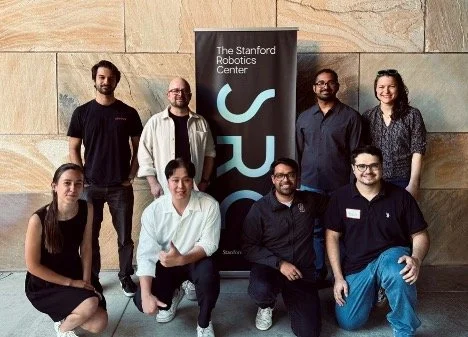
Thank you also to the student organizing committee: Shantanu Prakash, Ina Natseva, Yalcin Tur, and Chris Kwak
Author: Shantanu Prakash
Shantanu is an MS/MBA candidate at Stanford focused on Physical AI and Robotics.
Chelsea Finn • Brad Porter • Chetan Parthiban • Kaan Dogrusoz • Shantanu Prakash • Ina Natseva • Yalcin Tur • Chris Kwak • Steve Cousins